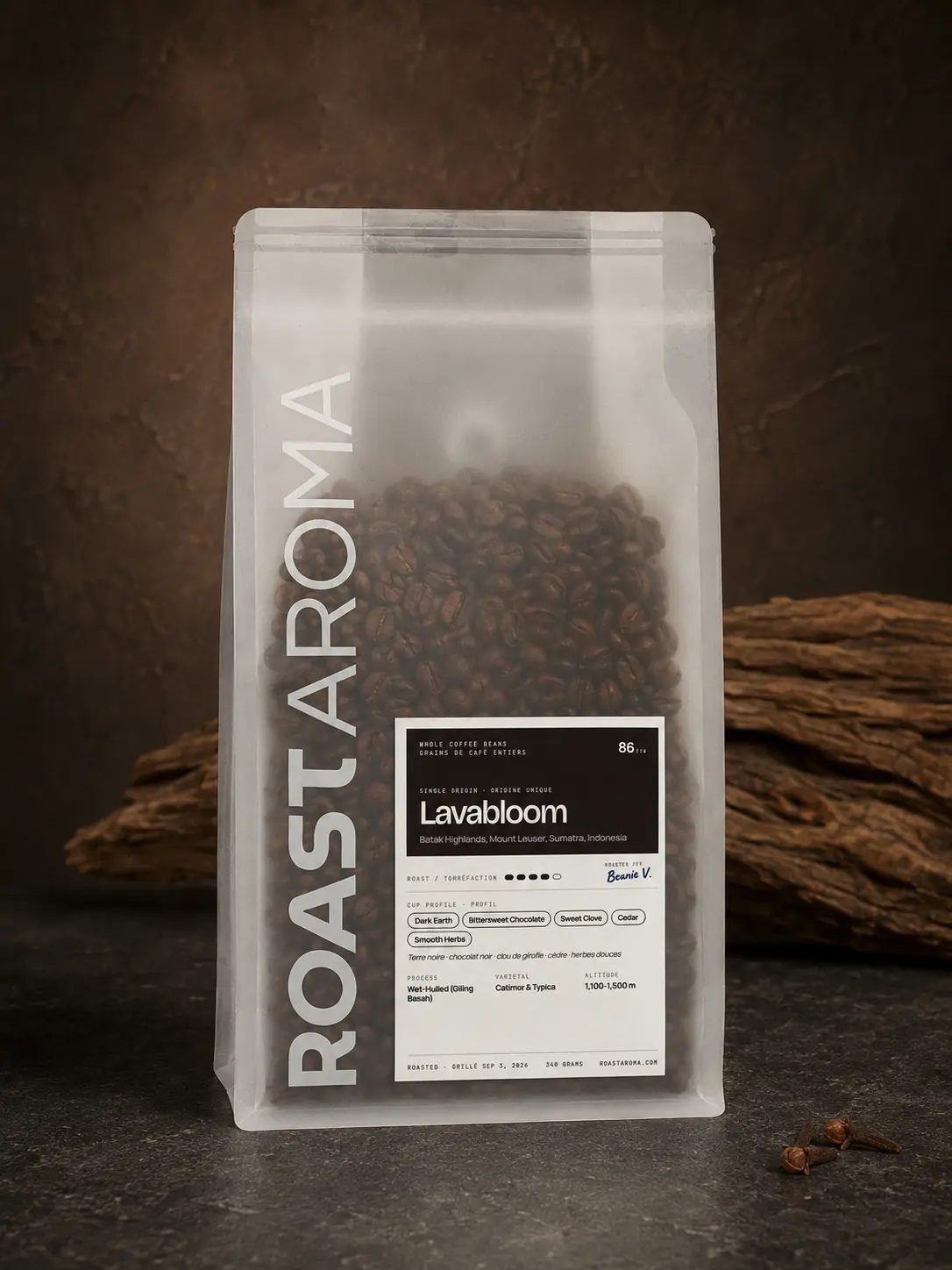
Lavabloom takes its character from the Batak highlands of west-central Sumatra, where coffee trees grow between 1,100 and 1,500 metres above sea level on slopes shaped by the Leuser Range — one of the last ecosystems on earth where tigers, elephants, orangutans, and rhinoceroses still share the same forest canopy. The volcanic soil here, enriched by centuries of ash and organic matter, imparts a flavour density that agricultural science has not found a shortcut to. Slow cherry ripening in the enclosed, humid microclimate does the rest. It is a terroir defined not in seasons, but in geological time.
The coffee carries the name Mandheling as tribute to the Mandailing people of the Batak highlands, the principal harvesters of this origin across generations. This is not plantation coffee produced at distance from the land. Lavabloom comes from smallholder farmers — most working plots of fewer than two hectares — whose agricultural knowledge moves through families rather than training programmes. Their intimacy with the land's weather, its drainage, its microclimates, produces a coffee of characteristic consistency and a cup that cannot be engineered. The Mandailing people did not name a coffee origin; they became one.
What makes Sumatran coffee singular in the specialty world is a processing method that exists almost nowhere else: Giling Basah, or wet-hulling. Where conventional washed and natural processes remove the parchment layer from the bean at 10–12% moisture content, Giling Basah strips the parchment at roughly 50% moisture — exposing the swollen, jade-green bean directly to sun-drying in its most open state. The bean's cell structure becomes porous and receptive, already imprinted with the concentrated character of its origin before a single roasting decision is made. It is a method born of necessity in Sumatra's unrelenting humidity, refined across generations into something that produces a cup profile found nowhere else on earth.
That elevated-moisture hulling actively constructs the flavour architecture of the finished cup. The deeply full body and characteristic low acidity that define Sumatran coffee are not accidents of terroir — they are consequences of process. Sun-drying at this stage draws herbal complexity to the surface and amplifies the spice notes latent in the volcanic soil. The earthiness that emerges at the cupping table is not muddy or raw but grounded and clean — the difference between a terroir expressed and a processing shortcut taken. Lavabloom is the former.
Roasted to a deliberate medium-dark profile to honour the depth this bean was built to carry, Lavabloom opens with dense, concentrated earthiness that anchors the cup from first contact. Bittersweet chocolate deepens as the temperature falls, joined by the warmth of sweet clove and dry cedar — quiet spice notes that surface the volcanic personality of Mount Leuser in every sip. The body is syrupy and full, with a mouthfeel that settles and holds. As the cup cools, the herbal finish becomes the story: clean, pronounced, and smooth in a way that only Giling Basah and the right roast level together can produce. This is not brightness. This is depth, earned.
Lavabloom is not a gentle cup. It is the Leuser Range in a bag — ancient, complex, and entirely uncompromising — roasted to the level its character demands and offered to those who want their morning to carry weight. Available while quantities last.