TL;DR: Coffee grind size is the single most important variable for controlling extraction. Use 400-600 microns for pour-over, 200-300 microns for espresso, and 800-1000 microns for French press. Match grind size to brew time—coarser for longer contact, finer for shorter. Invest in a quality burr grinder for consistent particle distribution.
Why Grind Size Matters More Than Any Other Variable
If you're brewing specialty coffee at home and struggling with sour or bitter cups, your grind size is almost certainly the culprit. While water temperature, brewing ratio, and timing all influence extraction, grind size controls the fundamental physics of how water interacts with your coffee.
When you grind coffee, you're increasing surface area exponentially. A whole bean has minimal surface area; grind it to espresso-fine, and you've created thousands of particles, each with exposed cell walls ready to release soluble compounds. The science is straightforward: finer grinds extract faster because water contacts more surface area, while coarser grinds slow extraction due to reduced contact.
Research published in the Journal of Food Science demonstrates that particle size distribution directly correlates with total dissolved solids (TDS) and extraction yield. Uneven grinding—what happens with blade grinders—creates a bimodal distribution: some particles are dust-like and over-extract, while others are boulder-sized and under-extract. The result? A cup that manages to be both sour and bitter simultaneously.
Understanding Particle Size: The Micron Scale
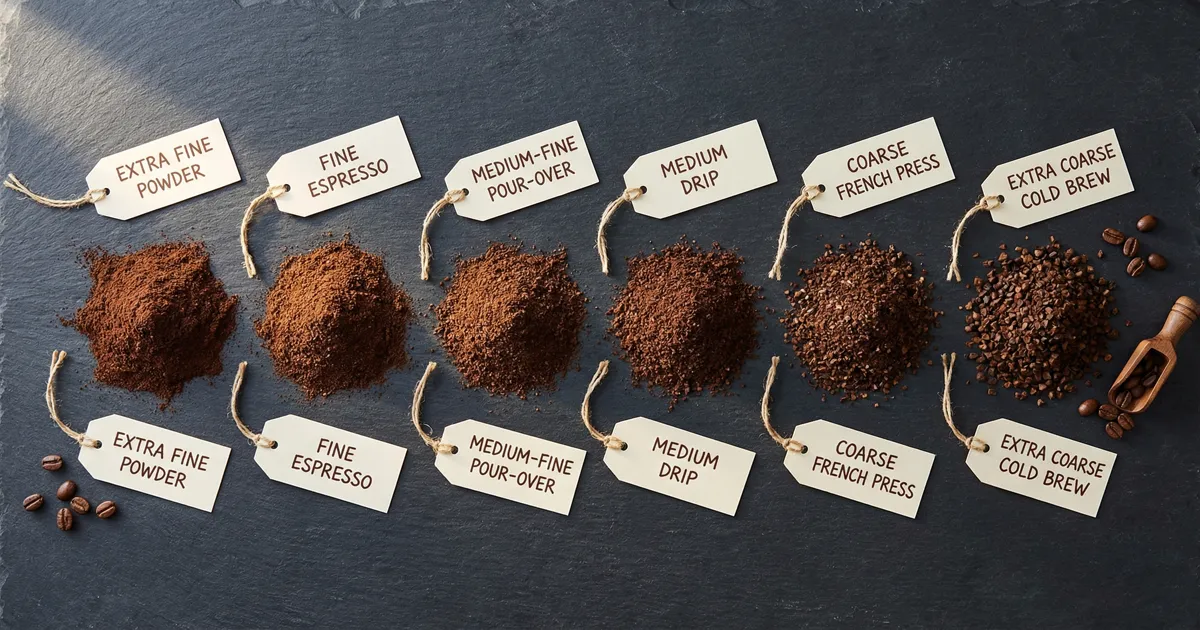
Coffee grind size is measured in microns (μm)—one millionth of a meter. To visualize: a single coffee ground ranges from 200 microns (fine as table salt) to 1500 microns (coarse sea salt). The Specialty Coffee Association defines standard ranges, but real-world brewing requires understanding how these measurements translate to taste.
Here's what the micron scale looks like in practice:
• Turkish: 50-150 microns (powder-fine, like flour)
• Espresso: 200-300 microns (fine sand consistency)
• Pour-over/Drip: 400-600 microns (medium-fine, like granulated sugar)
• Chemex: 500-700 microns (medium, slightly coarser than pour-over)
• French Press: 800-1000 microns (coarse, like sea salt)
• Cold Brew: 1000-1500 microns (extra coarse, coarse pepper)
Grind Size by Brewing Method: A Complete Reference
Espresso: The Precision Zone (200-300 microns)
Espresso demands the finest, most consistent grind of any brewing method. With water forced through grounds at 9 bars of pressure for just 25-30 seconds, extraction happens rapidly. Too coarse, and water rushes through, producing thin, sour shots. Too fine, and you create channeling or completely choke the machine.
The target is 200-300 microns—fine enough to create proper resistance, coarse enough to allow even flow. On most burr grinders, this falls between settings 1-3 (finest quarter of the range). When properly dialed in, espresso grind should feel like fine sand that barely clumps when pinched.
Pour-Over: The Sweet Spot (400-600 microns)
Pour-over methods like Hario V60, Kalita Wave, and Origami require medium-fine grinds in the 400-600 micron range. This creates the right balance: enough surface area for proper extraction during the 2.5-3.5 minute brew time, but not so fine that the bed chokes or over-extracts.
Visual reference: Proper pour-over grind resembles granulated sugar or coarse sand. Individual particles should be visible but small. When you rub grounds between your fingers, you should feel texture without grittiness.
French Press: The Coarse Approach (800-1000 microns)
French press immersion brewing requires a coarse 800-1000 micron grind for two critical reasons: sediment control and extraction management. The metal mesh filter allows fine particles through, and the 4-minute steep time extracts efficiently even with larger particles.
The Science of Extraction: What Happens at Different Grind Sizes
Coffee extraction follows predictable chemical phases. Understanding these helps you diagnose grind-related problems.
First comes acid extraction (0-20% of brew time): citric, malic, and phosphoric acids dissolve quickly, creating brightness. With too coarse a grind, you might extract only acids, resulting in sour, thin coffee. Fine grinds extract acids faster, which is why proper timing matters more with finer settings.
Next, sugar extraction (20-60% of brew time): sucrose and reducing sugars develop, creating sweetness and body. This is the desirable zone. Grind size determines how quickly you reach this phase—finer grinds get here faster, but also exit it faster, risking over-extraction.
Finally, bitter compound extraction (60%+ of brew time): chlorogenic acids, caffeine, and phenolic compounds dissolve. These provide structure but quickly become harsh. Coarse grinds naturally limit this phase during normal brew times, while fine grinds risk over-extraction if contact time extends too long.
Grinder Selection: Why Your Equipment Matters
The quality of your grinder matters more than the quality of your brewer. A $300 grinder with a $30 pour-over setup produces better coffee than a $30 blade grinder with a $300 drip machine. Here's why: particle distribution.
Burr grinders crush coffee beans between two abrasive surfaces, producing relatively consistent particle sizes. Blade grinders chop beans randomly, creating dust and boulders simultaneously. The result is uneven extraction no matter how carefully you brew.
Entry-Level Excellence: Timemore C2
The Timemore C2 ($80-100 CAD) delivers exceptional value. With stainless steel burrs and consistent particle distribution, it outperforms electric grinders costing twice as much. The click adjustment system provides clear feedback, and it handles pour-over to French press ranges beautifully. Limitation: It struggles with true espresso-fine grinding.
Espresso Specialization: KINGrinder K6
For espresso enthusiasts, the KINGrinder K6 (~$150 CAD) offers espresso-capable grinding with exceptional consistency. The external adjustment dial moves in 16-micron steps—60 clicks per rotation across four full rotations—giving you fine enough control to dial in a shot properly. Stainless steel conical burrs with dual-bearing alignment keep particle distribution even, and the range covers espresso through French press with precision.
Electric Convenience: Baratza Encore ESP
The Baratza Encore ESP ($200-230 CAD) brings electric convenience without sacrificing quality. The ESP (Espresso) model extends the grind range finer than the original, making it viable for entry-level espresso. Repairable, reliable, and backed by excellent customer support.
Troubleshooting: Reading Your Coffee's Signals
Your cup tells you when grind size is wrong. Here's how to interpret the signals:
Sour, thin, lacking body? Your grind is too coarse. Water rushed through without extracting sugars and oils. Go finer by 1-2 clicks and taste again.
Bitter, harsh, astringent? Your grind is too fine. Over-extraction pulled too many bitter compounds. Go coarser by 1-2 clicks.
Uneven, some sips sour and some bitter? Your grinder is producing inconsistent particle sizes. Time to upgrade from a blade grinder or replace worn burrs.
Conclusion: Mastering Grind Size
Grind size is your most powerful tool for controlling coffee extraction. By understanding the micron scale, matching grind to brewing method, and investing in quality grinding equipment, you can transform your home coffee from mediocre to exceptional.
Start with the reference ranges in this guide, but remember: taste is the ultimate judge. Use these recommendations as starting points, then adjust based on what you taste in the cup. Keep a brewing journal noting grind settings, times, and results. Over time, you'll develop an intuitive understanding of how grind size affects your specific setup.
Ready to put this knowledge into practice? Browse our selection of specialty coffee and start dialing in your perfect grind today.